Highest Energy Efficiency
Very compact and insulated design combined with closely arranged heating elements in the calcination zone ensures optimal heat transfer and maximum efficiency.

Building on more than two decades of expertise in conveying hot materials – including proven solutions like the KZB-S (up to 1,000 °C), BZB-H-I (up to 850 °C), and FPB-K (up to 850 °C) – together with Holcim, AUMUND has developed the electrified Linear Calcination Conveyor, in short eLCC. The eLCC is a patented, energy-efficient solution for the production of calcined clay.
The eLCC technology addresses the critical challenge of clay calcination, which requires precise temperature control at 750–800 °C – significantly lower than traditional clinker production temperatures. This temperature reduction, combined with the eLCC’s energy-efficient design, contributes substantially to the overall carbon footprint reduction achieved by LC3 cement.
Up to 40 %
Zero
The electrified Linear Calcination Conveyor (eLCC) is a patented, energy-efficient solution for the production of calcined clay, a key component of low-carbon cement. Based on AUMUND’s robust pan conveyor technology, the eLCC benefits from decades of field-proven reliability.
The modular design architecture allows production capacities to be expanded seamlessly by adding additional modules, providing exceptional flexibility for system expansion and long-term scalability as market demand for LC3 cement grows. The system offers simplicity in operation while enabling fine-tuning through precise control of temperature and speed.
The eLCC’s specific energy requirement is significantly lower compared to alternative solutions due to its completely enclosed and insulated design. The compact heating chamber volume reduces heat losses substantially and enables rapid system startup, providing unprecedented operational flexibility for plant operators.
Very compact and insulated design combined with closely arranged heating elements in the calcination zone ensures optimal heat transfer and maximum efficiency.
Short start-up times enable flexible operation frequencies and easy, quick adaptation to operational requirements.
The modular system allows production capacity to be increased at any time simply by adding further eLCC modules.
Only a minimal number of parts such as chains, rollers and sprockets require maintenance, which, based on AUMUND technology and experience, ensures long service life.
The eLCC offers a semi-mobile design, allowing flexible installation directly at the clay deposit when located far from the cement plant. This setup significantly reduces transport costs and, thanks to its modular structure, the unit can be relocated easily whenever operational needs change.
The cement industry faces unprecedented pressure to decarbonize, accounting for approximately 8 % of global CO2 emissions. LC3 (limestone calcined clay cement) presents a transformative opportunity to reduce emissions and unlock economic benefits within existing industry infrastructure.
The synergy between calcined clay and limestone creates complex pozzolanic reactions, with calcined clay providing additional alumina that reacts with limestone to form carboaluminate phases, contributing significantly to strength and durability while maintaining comparable or superior performance characteristics to conventional cement.
LC3 is a blend of approximately:
Compared to 95 % in ordinary Portland cement.
Produced energy-efficiently with the AUMUND eLCC.
Reacts with the calcined clay to form carboaluminate phases.
Completes the LC3 blend.
This blend reduces carbon emissions in the cement production process by up to 40 % compared to ordinary Portland cement. Source: lc3.ch
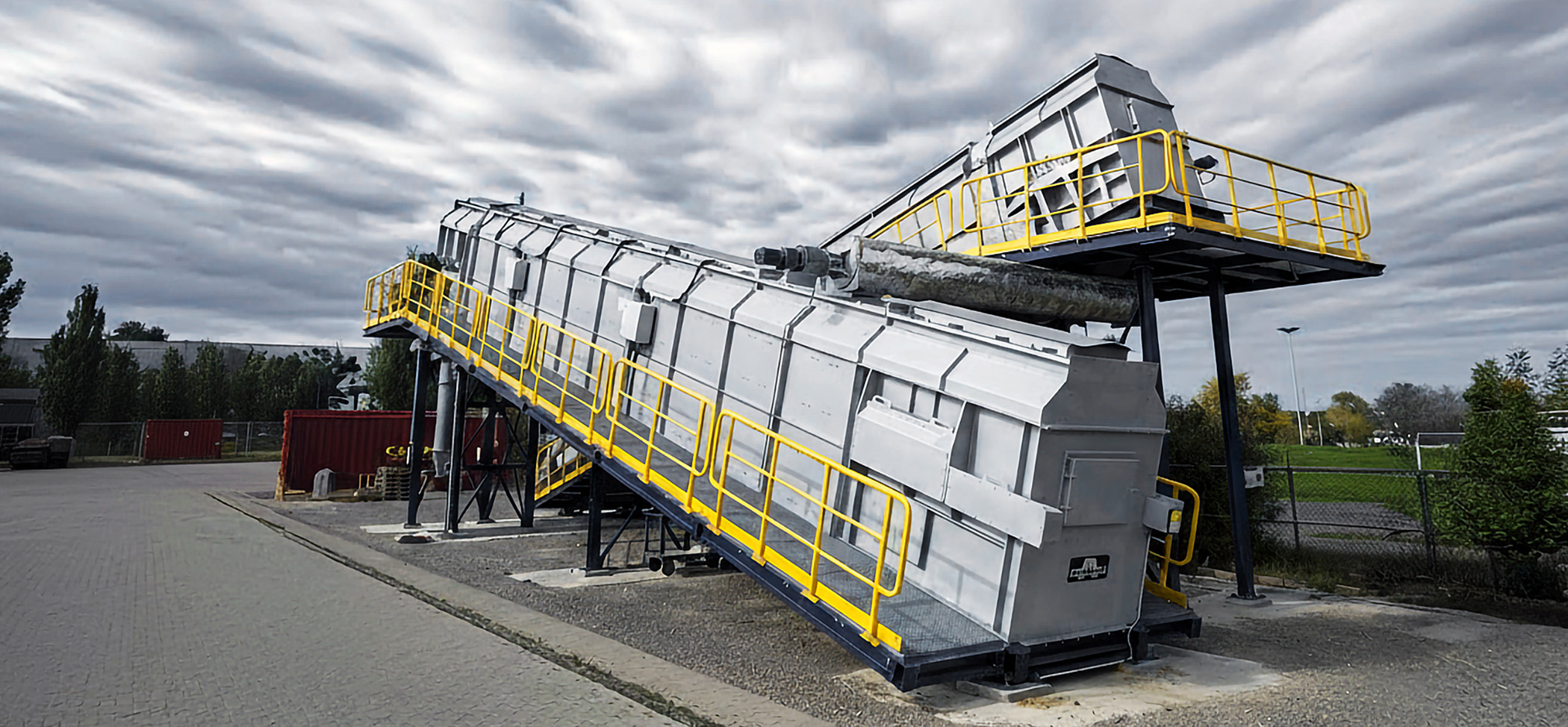

Clay calcination requires precise temperature control at 750–800 °C. The eLCC enables fine-tuning through precise control of temperature and speed.
The completely enclosed and insulated design and the compact heating chamber volume reduce heat losses substantially and enable rapid system startup.
Closely arranged heating elements in the calcination zone ensure optimal heat transfer. They can be powered entirely by renewable energy sources such as wind or solar power.
In addition to electric heating, the eLCC can accommodate various heating systems including ceramic gas burners.
The eLCC is based on AUMUND’s robust pan conveyor technology and more than two decades of expertise in conveying hot materials with the KZB-S, BZB-H-I and FPB-K.
Production capacity can be increased by adding further eLCC modules. The semi-mobile design allows installation directly at the clay deposit and easy relocation.
Technical requirements may be adjusted to your requirements.
| Production capacity clay | Conveyor length | Conveyor width | Conveyor speed | Heat capacity |
|---|---|---|---|---|
| 20 t/h | 3 x 45 m | 800 mm | 0.1 m/s | 8 MW |
| 40 t/h | 3 x 70 m | 1,000 mm | 0.1 m/s | 16 MW |
| 80 t/h | 4 x 70 m | 1,400 mm | 0.1 m/s | 32 MW |
| 100 t/h | 4 x 70 m | 1,600 mm | 0.1 m/s | 40 MW |
*Variations depending on raw material properties.

AUMUND has more than two decades of expertise in conveying hot materials, including proven solutions like the KZB-S (up to 1,000 °C), BZB-H-I (up to 850 °C) and FPB-K (up to 850 °C).
The eLCC was developed by AUMUND together with Holcim as a patented, energy-efficient solution for the production of calcined clay.
Powered by renewable energy, the eLCC enables completely carbon-neutral calcination processes with zero direct CO2 emissions, representing a fully sustainable cement production technology approach.
The AUMUND Group operates Service Centres and Warehouses for spare parts in Germany, the USA, Brazil, Hong Kong, Saudi Arabia, and in Great Britain. Almost 60 dedicated Supervisors tend to clients’ needs across the globe.
Clay calcination requires precise temperature control at 750–800 °C – significantly lower than traditional clinker production temperatures.
Yes. The electric heating elements can be powered entirely by renewable energy sources such as wind or solar power, enabling calcination with zero direct CO2 emissions. The eLCC can also accommodate other heating systems, including ceramic gas burners.
Standard configurations range from 20 t/h to 100 t/h of clay. Technical requirements may be adjusted to your requirements; variations depend on raw material properties.
Yes. The modular system allows production capacity to be increased at any time simply by adding further eLCC modules.
Yes. The semi-mobile design allows flexible installation directly at the clay deposit when it is located far from the cement plant. This significantly reduces transport costs, and the unit can be relocated whenever operational needs change.
LC3 (limestone calcined clay cement) is a blend of approximately 50 % clinker, 30 % calcined clay, 15 % limestone and 5 % gypsum. It reduces carbon emissions in the cement production process by up to 40 % compared to ordinary Portland cement.
For more information about the AUMUND eLCC and project-specific requirements, please contact our sales team.
If we can help you with any further information, please use the contact form to get in touch.
You will receive an immediate automated acknowledgement, and we will respond to your enquiry as soon as possible.
Many thanks
AUMUND. SCHADE. SAMSON.